Equities notched fresh highs in the September quarter and the IPO market was a bustle of activity. This is despite consumer sentiment sliding to a four-month low and macroeconomic commentary debating recession risk. Gold rocketed ~12% in September alone, punching through its inflation-adjusted peak, with the bid bleeding into silver, copper, palladium and other precious metals. This quarter was defined by the paradox between a weakening US economy and a stubbornly strong US market, which continues to reinforce themes we’ve flagged before including US exceptionalism vs valuation risk and potentially better value offshore. We continue to remain underweight the US, particularly given the tail risk of policy volatility, and are finding more compelling opportunities elsewhere.
One of those places is Poland. CD Projekt, our third-largest contributor since inception and still a top-three position, is worth examining in detail because it exemplifies what we're finding offshore: quality businesses undergoing structural transformations that create significant mispricings.
CD Projekt has a problem most companies would kill for. They're one of the highest returning game developers in the world, but until recently, they couldn't deploy more capital at those exceptional rates. The business was like a brilliant chef stuck in a tiny kitchen: excellent returns on every dish, but impossible to scale output.
Single-track game development created a natural ceiling. You can't double investment in one game and expect to double the revenue. One masterpiece every four to five years generates strong returns but limits growth. Their new model of dual-track AAA development plus incremental projects through 2035 attempts to break this constraint. Can they maintain those high returns while scaling capital deployment? The shift from cyclical hitmaker to steady-state compounder changes the valuation mathematics entirely.
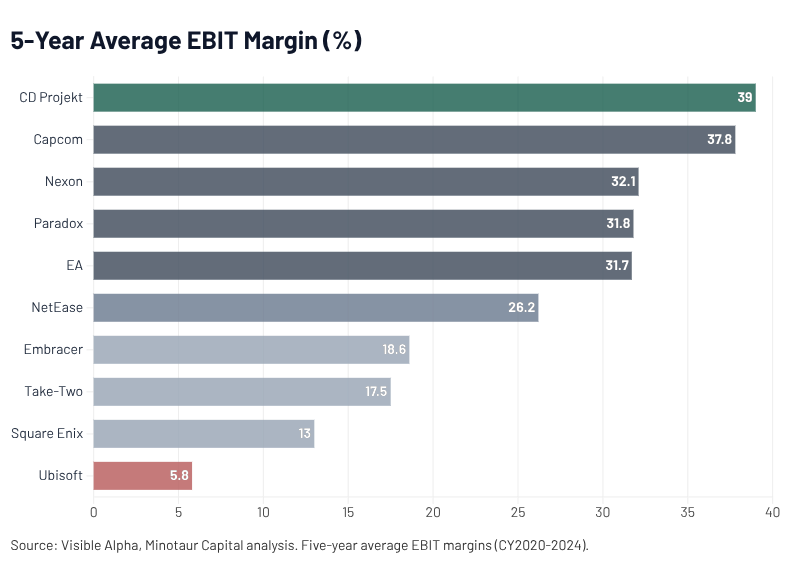
Most investors give game studios a miss because the accounting lies. All the real capital goes into people, not plant, so traditional return on capital metrics break. We've found that looking at a five-year average of EBIT margins cuts through the noise, smoothing release cycles to reveal which teams consistently convert investment into profit. On this measure, CD Projekt sits near the top of the global industry with 39% margins.
The 2024 results demonstrate this. They delivered 365 million PLN (Polish zloty) in EBIT on 985 million PLN of revenue with no major release. The back-catalogue annuity model works.
The unit economics are proved out by exceptional returns. The Witcher 3 cost 306 million PLN and has generated over 2.4 billion PLN in lifetime revenue. Cyberpunk 2077 cost 1.2 billion PLN and has crossed 3 billion PLN despite its disastrous launch. Both broke even absurdly fast, with Cyberpunk on day one through pre-orders alone and The Witcher 3 within six to eight weeks.
Historical cadence limited deployment. Witcher 1 to 2 took four years, Witcher 2 to 3 another four years, Witcher 3 to Cyberpunk 2077 five years. There are natural limits to how much capital one title can productively absorb. The business printed cash but had nowhere to reinvest it at those high rates. Single-track development forced them into a cyclical pattern.
Dual-track development, which started in 2022, changes this fundamentally. Two AAA pipelines now run in parallel. Witcher 4, now with 444 developers, targets a 2027 release, while Cyberpunk 2, with 116 developers in a new Boston studio, enters pre-production for 2029-2031. Add incremental projects like a Witcher 1 remake via external partner Fool's Theory, new IP Hadar in long-term development, and multiplayer project Sirius and the mathematics shift dramatically. Five projects are now in active development — two AAA releases and three smaller or experimental titles — versus one historically. The business transforms from feast-or-famine to overlapping cycles with staggered franchise releases. A cyclical business becomes steady-state.
The pipeline represents substantial revenue potential through 2035, with sequential Witcher releases extending into the 2030s.
Several mechanisms enable this transformation. Switching to Unreal Engine 5 eliminates the burden of using the company’s proprietary games engine, REDengine. During The Witcher 3's development, there were times the engine would crash 20 to 30 times a day — a problem that persisted throughout the studio's decade-long struggle with maintaining their own technology. In June 2025 at Unreal Fest, CD Projekt showcased Witcher 4 running at 60 frames per second with ray tracing on PlayStation 5. Many considered these rendering technologies impossible on console hardware. Three years of co-development with Epic engineers de-risks execution. External partners like Fool's Theory multiply effective capacity without proportional headcount bloat. Geographic expansion into Boston for Cyberpunk 2, led by 20-year industry veteran and former BioWare designer Gabriel Amatangelo, provides access to North American talent without abandoning Poland's cost base.
The upshot of all this is that they can now deploy capital across multiple high-return projects simultaneously and thus the constraint is broken.
The tension emerges around execution velocity. They're attempting to compress development cycles from five years historically to three years for subsequent Witcher titles. After Witcher 4 launches in ~2027, they've committed to delivering Witcher 5 and Witcher 6 sequentially over the following six years. Meanwhile, Cyberpunk 2 develops in parallel through the Boston studio.
But there are risks — the last time they accelerated under pressure, they got Cyberpunk 2077's catastrophic 2020 launch with $51 million in refunds, delisting from PlayStation Store, and their stock crashing 75%.
Can they staff Witcher 4, scale Cyberpunk 2 to several hundred, manage external partners, and still maintain their historical margins? If labour costs rise 20-30% to attract top-tier talent across two studios, margins compress to 30-35%. Still strong, but no longer industry-leading. Historical precedent warns of failure, from BioWare's Anthem disaster during their multi-project push to Bethesda's Fallout 76 debacle.
Yet, several factors suggest it might work this time. Systematic process fixes post-2020 include agile methodology replacing waterfall development, cross-functional teams owning complete features, and continuous integration catching problems daily. Cyberpunk's expansion, Phantom Liberty, launched smoothly in 2023, proving the new methodology works.
Unreal Engine 5 creates capital efficiency through standardisation. Each project benefits from proven technology rather than reinventing the wheel. IP strength provides a quality floor. Even Cyberpunk 2077's disastrous launch resulted in 30 million copies sold. The Witcher 3 remains compelling ten years after its May 2015 release. Their positioning in dark fantasy and cyberpunk story-driven RPGs with literary foundations places them in a small global club alongside Bethesda's Elder Scrolls and Rockstar's Grand Theft Auto, with a distinct cultural voice.
Can they sustain dual-track development while maintaining margins? That would be enough to justify the thesis.
We invested in CD Projekt at the fund's launch in May 2024, with shares up 92% since. We remain investors because the transformation is only just beginning.
The business historically generated 300 to 400 million PLN in annual earnings during non-launch years, with spikes to 1+ billion PLN when major titles were released. Dual-track development changes this fundamentally. By 2030, with overlapping development cycles producing regular releases, core earnings should double to triple that historical baseline. Instead of cyclical spikes, you get compounding from a higher steady-state floor.
The valuation looks attractive as they execute on an accelerated cadence. Beyond that, optionality multiplies: Hadar offers long-term diversification into a third major franchise, Sirius tests new multiplayer monetisation models, and expansion into film and television through Netflix continues to unlock value from existing IP. None of this is necessary for the investment thesis, but it's what could drive them to a different scale entirely. The constraint that kept exceptional returns trapped in a small business is broken. Now we find out if they're as good at scaling as they are at making games. If they prove capable of building a multi-line entertainment business across games, film, and new IP, it's not out of the realm of possibility to think they could reach Take-Two Interactive's scale ($46bn+ USD market cap vs CD Projekt's ~$7bn today).
And we'll aim to stay on top of this through the use of our AI agents to monitor our CD Projekt position.
Most of what we’ve shown investors around our AI capability has been ‘reactive’ workflows. For example, we want to generate a ‘Snapshot’ of a company, so we have given LLMs a set of instructions around how to write that report, coupled with where to source data from (SEC filings, popular stock forums, all the news we’ve been collecting, price and consensus data, etc). We are now moving rapidly into the world of ‘proactive’ AI, where we set up dedicated agents for each company in our portfolio.
So what is the difference between a ‘workflow’ and an ‘agent’?
An AI workflow is like a recipe. It’s a fixed set of steps the AI follows every time to get something done. You decide the ingredients (data), the steps (process), and the output (result). The AI just executes those steps in an automatic and repeatable way. The Snapshot is a great example of this - that’s an AI workflow.
An AI agent, on the other hand, is like a personal assistant. It can think on its own and decide how to get to the goal. Instead of following a fixed recipe, it can reason, take actions, and adapt to new situations. It might use different tools or ask clarifying questions along the way.
For example, you tell the agent, “Find all of the relevant news on CD Projekt this week that could impact our investment thesis, key issues and theories on the stock,” and it figures out where to get the data, how to update the files and models, and how to present the results based on a large set of tools you might prescribe the agent.
This is the latest development in Taurient’s technology and we are super excited about it. The ability to have an agent dedicated to each stock can theoretically 50x our productivity. And why stop there? We should be able to eventually have agents for our entire watchlist.
As Aristotle said, “We become what we repeatedly do. Excellence, then, is not an act but a habit.” For our AI agents, that habit never breaks, scouring the Internet for developments on our stocks every day and hopefully proving out the excellence of our portfolio.