Minotaur Quarterly - June 2025

Minotaur Quarterly

June 2025
Minotaur Quarterly
June 2025
🌍
Macro Musings: Disorder, Dissonance and a Dash of Optimism

Against a backdrop of geopolitical noise, policy crosswinds, and a market that feels increasingly disconnected from fundamentals, the Minotaur Global Opportunities Fund soared 11.8% in the June quarter, outperforming our benchmark, the MSCI ACWI (in AUD) by 5.7%. Over the last 12 months, the Fund has returned 27% for our investors (8.6% better than our benchmark).

In the US, fiscal concerns are mounting. Ratings downgrades from all three major agencies, a deficit north of 6% of GDP, and 30-year Treasury yields breaching the 5% mark (albeit briefly) have stoked anxiety around sustainability. The dollar’s YTD slide (11% at June-end) reflects some of that unease, even as equities continue to grind higher.

Meanwhile, policy moves from the Trump administration created confusion around his trade stance, with legal challenges to existing tariffs and new dealmaking in the Middle East sparking hopes of AI-fuelled capex cycles, particularly in semiconductors and data infrastructure. Whether those hopes are well-founded remains to be seen.

Europe continues to be a solid performer, though we trimmed our outsized allocation to European defence after strong gains, primarily to manage risk. While the headlines have been noisy, we’ve managed to stay grounded, anchored by our research, diversified exposure, and increasingly powerful AI tooling. As we reflect on our first full financial year, the world may be messy, but clarity of process has never felt more essential.

With that in mind, one of the things we wanted to reflect on in this quarterly is our investment process.

🧠
UNDERSTANDING OUR INVESTMENT PROCESS: SIMPLE IDEA, HARD TO REPLICATE

Our investment process is occasionally described as complex, usually in contrast to peers who publish straightforward checklists of what they look for in a business (or what they avoid). These frameworks are certainly easy to understand. And for some investors, they’re enough. But ease of explanation often comes at the expense of edge.

We don’t do style boxes. We do mispricings.

At Minotaur, our approach starts with a simple idea. We invest in businesses where we believe the market is mispricing the future. That’s it. We’re not a value fund, we’re not a growth fund. We’re a mispricing fund.

Our edge comes from asking: "What is the market getting wrong about the future of this company over the next three to five years?" We’re looking for moments where consensus breaks down. That might be around strategy shifts, misunderstood capital cycles, hidden earnings power, or just plain apathy. What unites our investments isn’t their style factor or a tick-the-box exercise. It’s the presence of a thesis, a variant perception, and the opportunity to be right when the market is wrong.

🧰
AI AS OUR RESEARCH MULTIPLIER

One of the reasons our process may seem more intricate is that we do things most funds simply can’t (or won’t) do at scale. Our proprietary software, Taurient, helps us surface opportunities others might miss. It’s not there to replace our portfolio managers, it’s there to amplify them. Think of it as our idea-generation engine, our early-warning system, and our sceptical research partner all in one.

We wouldn’t necessarily label ourselves as “an AI fund” - and we certainly don’t just invest in AI - but AI is baked into how we operate. It helps us interrogate edge cases faster, push further into non-obvious data, and benchmark ideas across a global opportunity set. In a world where replication is increasingly easy, our tech stack makes imitation harder.

💰
BREADTH WITHOUT DILUTION = CONSISTENT RETURNS

Where many funds lean heavily into a single style - be it quality, growth, or deep value, for instance - we deliberately resist style rigidity. Why? Because styles go in and out of favour, but mispricings exist in every market regime.

We are flexible by design, unconstrained by geography, sector, or factor. We don’t want to come to our investors at year-end and say, “We underperformed because growth underperformed,” or “because mid-caps were out of favour” or “because Australia is overvalued right now.” We are investors in this fund ourselves and we hold ourselves to a higher bar.

From mega-caps to micro-caps, we go where the disconnect is.

This flexibility also helps us manage risk. We typically hold 40 to 60 stocks across regions, sectors, and style buckets. Each one has its own distinct mispricing thesis. This allows for a mix of stocks that we believe are all good opportunities but aren’t correlated. The idea is that while not every single thesis will play out perfectly, being right on average across a diversified set of ideas can lead to robust overall returns. It’s this portfolio construction ethos, diversification without dilution, that helps smooth performance over time while retaining the potential for outperformance.

Some have accused us of being “too diversified”. Interestingly, in the global context, 40 stocks would be seen as more on the concentrated side of the concentration/diversification spectrum. Nonetheless, here in Australia, there is a love affair with highly concentrated 10-20 “best ideas in the world” portfolios. We are not saying that doesn’t work. It’s just not what we do or what we’re comfortable with. AI is a part of our investment team, so we can keep on top of the key drivers of a 40-60 stock portfolio. And the beauty of it is, our research shows that if you were to add us alongside the popular highly concentrated global portfolios of Australian-based fund managers, you would actually increase your returns and lower the overall risk of your portfolio.

🔍
WHAT DOES A MISPRICING LOOK LIKE?

The shape of mispricings can vary dramatically, as seen in the five examples below from our portfolio. We’ve invested in:

  • Rheinmetall: A misunderstood defence name in the midst of Europe’s biggest rearmament cycle in decades.
  • Cover Corp: A small-cap creator economy play in Japan that doesn't fit any conventional institutional screen.
  • Chugai Pharmaceutical: A large-cap Japanese pharma company where the market is mispricing two exciting GLP-1 opportunities.
  • NVIDIA: A mega-cap growth name where we believe the market is still underappreciating long-tail earnings from inference.
  • Wizz Air: A European ultra-low cost carrier undergoing a high-conviction turnaround, where we see clear potential for re-rating as one-off headwinds fade.

Each of these looks nothing like the other. The unifying thread is having a differentiated view of the future, backed by a clear thesis and conviction that consensus is wrong. We know you love a detailed stock write-up, so below is one more example of a mispricing in more detail.

🧸
MINISO: A SURPRISINGLY SOPHISTICATED VALUE RETAILER

Miniso wasn’t on anyone’s “high-conviction” list. Which is precisely what made it interesting.

Taurient flagged Miniso as a new idea in January 2025 from a South China Morning Post article. The article outlined the company’s surprise move to issue US$550m in debt to fund its global expansion ambitions, with a stated goal of reaching 40,000 stores and to support share buybacks. For a business labelled a Chinese “dollar store,” this was an unusually bold act of capital allocation. Most of the market overlooked it. Taurient didn’t.

Digging deeper, we found something more ambitious than we expected: a capital-light global retailer enacting a strategic pivot into IP-driven merchandising and collectibles with improving unit economics. The company is scaling efficiently via a high-return, capital-light partnership and distribution model. It has quietly accumulated over 7,700 stores in 110+ countries, while improving store-level productivity and profitability in international markets. Top-line growth was robust (2020-2024 revenue CAGR of 22%), but earnings were growing even faster with adjusted net profit CAGR of 70% over the same period. Management has guided to doubling the number of stores from 2023 to 2028, with new store breakevens typically in 12-18 months.

🚀 From “Cute and Cheap” to Compounder

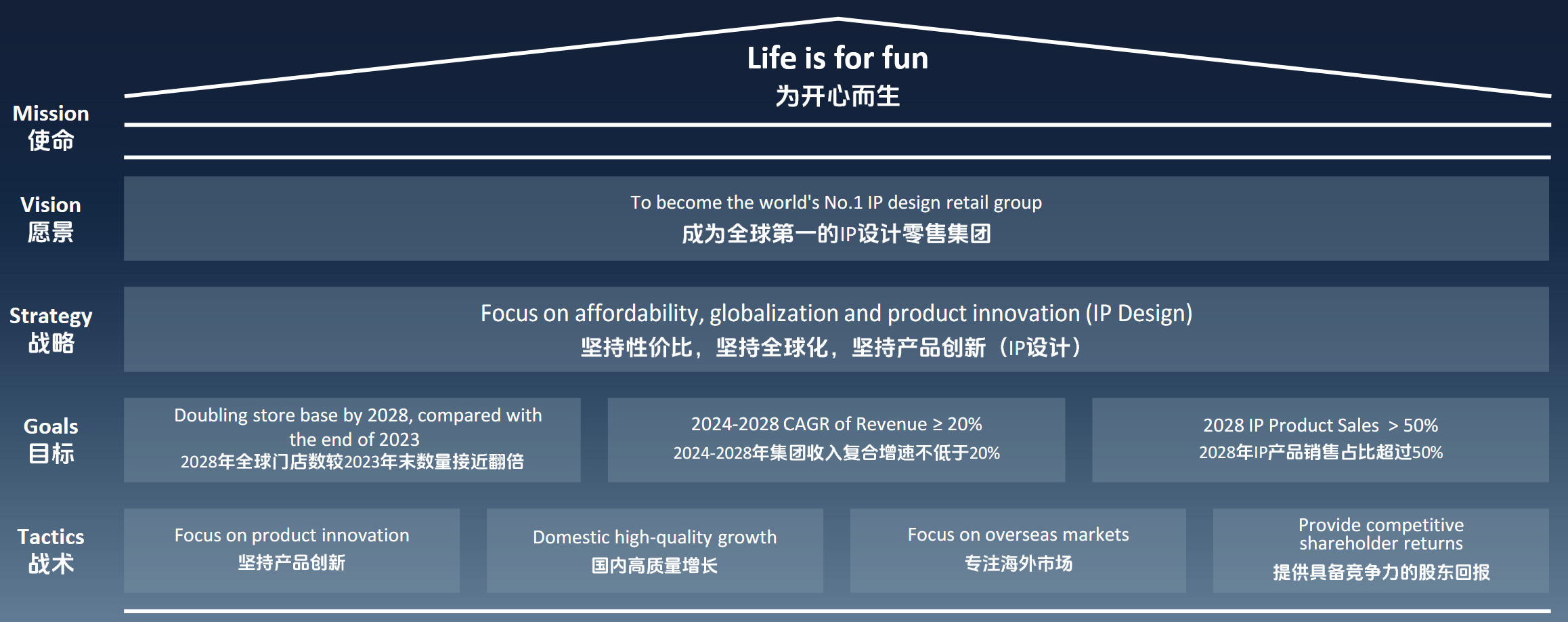
Our variant thesis was that the market was too focused on Miniso’s ‘cheap and cheerful’ past and not paying enough attention to its emerging ‘compounder’ profile: Mid-40s gross margins, high teens ROIC, +20% EPS growth and a structural mix shift to higher margin international stores. Miniso's strategy is no longer just about rolling out cheap gadgets and plushies. It’s now grounded in three pillars: globalisation, IP-driven product innovation, and affordability. The company is targeting +20% revenue CAGR and expects more than half of its revenue to come from IP products by 2028.

Miniso’s internal mission is to become the #1 IP design retail group globally, supported by expanded brand partnerships (e.g. Disney’s Stitch, Miffy, Hello Kitty), store clustering in key regions, and brand-localisation playbooks across Asia, Europe, and the Americas.

Miniso Strategic Roadmap from 1Q25 Presentation

Execution has largely kept pace with ambition. The company grew revenue 18.9% yoy in 1Q25, gross margin hit a record-high of 44.2%, and international revenue rose 30% yoy. That said, not everything has gone smoothly. Management missed consensus EPS estimates in this same quarter and flagged pressure from rising operating costs, foreign exchange headwinds, and slower domestic same store sales growth.

🌍 Strategy in Motion: The International Shift

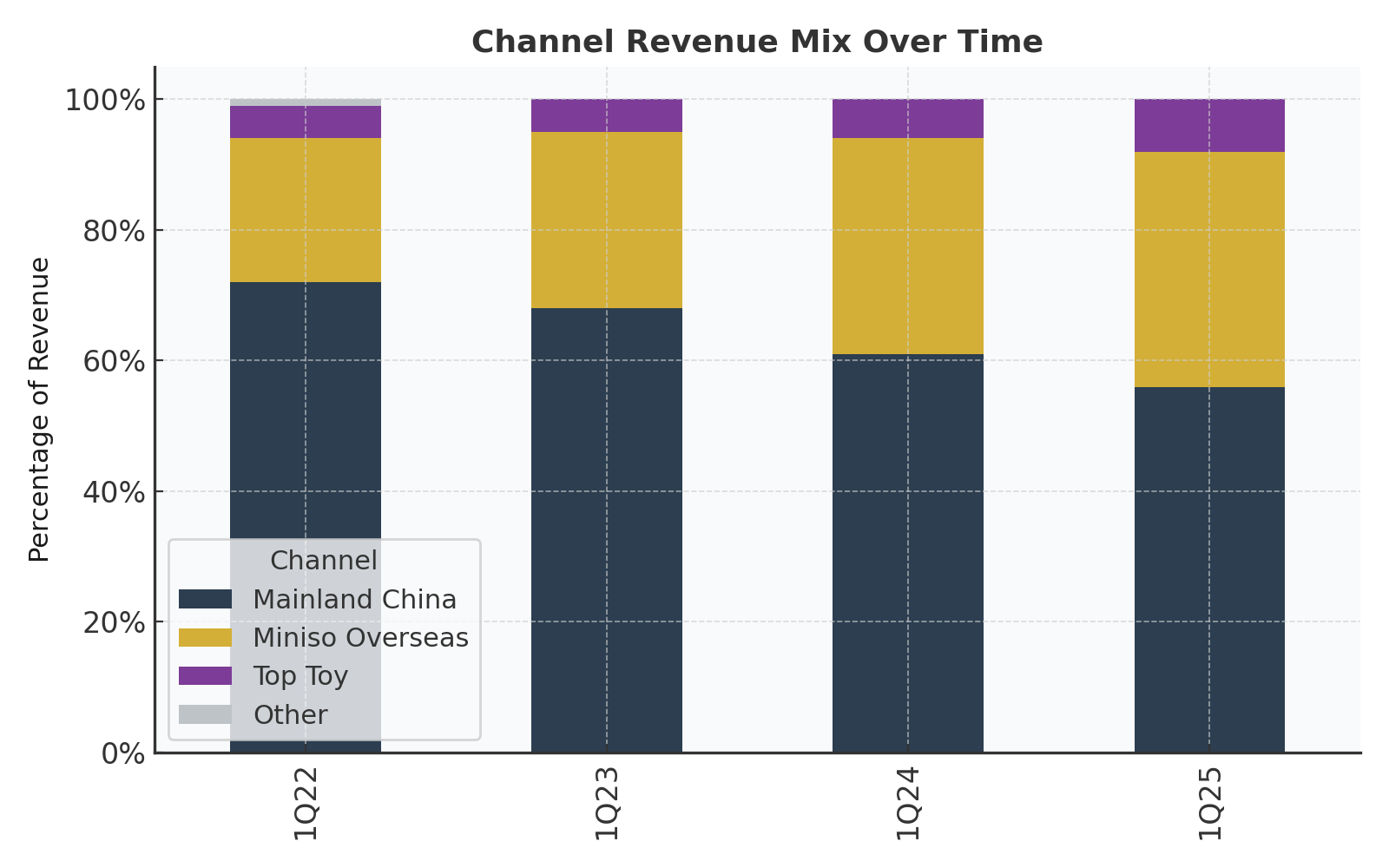
One of the clearest structural shifts underway is the transition of revenue away from China and into international markets. In 1Q22, 72% of revenue came from China. By 1Q25, that number had dropped to 56%, with overseas revenue climbing from 22% to 36% in just three years. The overseas business not only grows faster, but also carries higher gross margins and is less sensitive to domestic Chinese macro.

🆚 A side-note - The Pop Mart Comparison

Taurient also flagged Pop Mart from an article in the business section of Malaysian newspaper, The Star, about the company's aggressive global expansion. You'd be forgiven for thinking Pop Mart is far more exciting in comparison to Miniso. It’s trading on hope and emotion, much like the blind-box collectibles it touts. And to be fair, it has earned that hype: triple-digit revenue and profit growth in 2024, a global fanbase that goes a little crazy when they open blind boxes, and impressive expansion across Southeast Asia and Europe. But it’s also priced at just over 30x 1 year fwd PE or a PEG of 1.5x.

By contrast, Miniso is trading at 14.5x 1 year fwd PE, with a PEG under 1.0, a 3% dividend yield, and strong free cash flow. It’s not chasing growth at all costs. It appears to be scaling smartly, retaining pricing power, and returning capital – 58% of 2024 adjusted net profit was returned to shareholders via dividends and buybacks.

Both businesses tap into the same global trend: impulse-driven, emotionally engaging consumerism. But we believe Miniso gives us that exposure with greater earnings durability, a broader SKU footprint (or less Labubu concentration risk), and less valuation risk.

Our investment framework is designed for signal triangulation. In this case, Taurient’s post-earnings price alert in May for Miniso triggered our entry in June. This created a setup where we could enter below consensus fair value, but still in alignment with the long-term variant thesis.

At present, we are only modestly up on this relatively new position, though we believe the story is still playing out. We think Miniso is continuing to evolve into a multi-category, cross-border, brand-led consumer ecosystem. And the best part is that it’s still priced like a commodity retailer.

We are keeping a close watch on it, particularly given the disappointment in the last quarter. But we’re happy being long what we think is a solid mispricing story with asymmetric upside, a clear margin structure, and real cash returns along the way. We concede that whether Miniso or Pop Mart ends up being the better investment remains to be seen, but it's an example of how we balance risk vs. reward prudently and is a good example of Taurient and our PMs coming together to do just that.

🛠
WHY THIS PROCESS CAN’T BE REDUCED TO A CHECKLIST

We respect firms that use checklists. Their processes are elegant and internally consistent. But in our view, the very clarity that makes them easy to explain also makes them easier to compete away, particularly in a world where LLMs and AI tooling can scrape, score, and systematise checklist-driven strategies with increasing precision.

We’re playing a different game. One where our edge lies in insight, not in box-ticking. One where ideas can come from a Japanese-language news article flagged by AI at 2am, or a strategic pivot that hasn't yet registered in valuation screens.

It may look complex from the outside. But at its core, it’s simple: Find businesses where the market is wrong. Know why it’s wrong. And have the courage to back it.

At the risk of mixing quotes, we are firm believers in what Peter Lynch said about, "The person that turns over the most rocks wins the game. And that’s always been my philosophy." You’d be hard-pressed to find a fund that turns over as many rocks in as many diverse corners as Minotaur. After all, a great stock is a bit like Plato’s accomplished heroes: "A hero is born among a hundred, a wise man is found among a thousand, but an accomplished one might not be found even among a hundred thousand men."

© 2024 Minotaur Capital Management Pty Ltd (Minotaur). All rights reserved. See our Privacy Policy.

Minotaur Capital Management Pty Ltd (ABN 17 672 819 975) is a corporate authorised representative (CAR 1308265) of Minotaur Licensing Pty Ltd (ABN 86 674 743 198) (AFSL 557080). The Minotaur Global Opportunities Fund is issued by K2 Asset Management Ltd (ABN 95 085 445 094, AFSL 244393), a wholly owned subsidiary of K2 Asset Management Holdings Ltd (ABN 59 124 636 782).

The information in this website (the Information) has been prepared by Minotaur.


This information is for general information only and is not an offer for the purchase or sale of any financial product or services. The Information has been prepared for investors who qualify as wholesale clients under section 761G of the Corporations Act 2001 (Cth) (Corporations Act) or to any other person who is not required to be given a regulated disclosure document under the Corporations Act. The Information is not intended to provide you with financial or tax advice and does not take into account your objectives, financial situation or needs. Although we believe that the Information is correct, no warranty of accuracy, reliability or completeness is given, except for liability under statute which cannot be excluded. Please note that past performance may not be indicative of future performance and that no guarantee of performance, the return of capital or a particular rate of return is given Minotaur, K2 Asset Management or any other person. To the maximum extent possible, Minotaur, K2 Asset Management or any other person do not accept any liability for any statement in this Information.